
Finances
Who Keeps the House in Divorce?

Deciding who keeps the house in divorce involves more than emotion. Learn the pros and cons of mortgage assumption, refinance, cash-out options, and selling — plus key considerations when children are involved.
The family home is more than just real estate — it represents stability, memories, and security. But in separation or divorce, the question is not simply who wants the house? It’s who can afford the house — and the mortgage — moving forward?
If you own a home together, when determining who keeps the house in divorce, there are typically three practical options to consider: mortgage assumption, cash-out refinance, or sale.
Frequently Asked Questions About Mediation

How long does mediation take? How does mediation differ from court? Does mediation require a retainer?
Read MoreDivorce Mediation After Marriage Counseling

Couples therapists, clergy members, or marriage counselors help spouses and co-parents rebuild trust, improve communication, and strengthen their relationship. However, despite best efforts, some couples reach a point where reconciliation is no longer possible. When this happens, the transition away from the relationship can be just as crucial as the attempts to save it.
Read MorePREPARE YOURSELF

The key to a smooth mediation process is preparation. Your mediator may ask you to gather documents to prepare for your session. These documents should include property and debts owned both individually and together.
Read MoreLet’s Talk Co-Parenting

Early during the divorce or separation process, parents will face the issue of how to handle shared parenting time and finances. In most cases, parents strive towards shared parenting time so that the children can spend time with both parents. The key is to take into consideration each parent’s work schedule, the children’s school schedules,…
Read MoreMediation for Separation
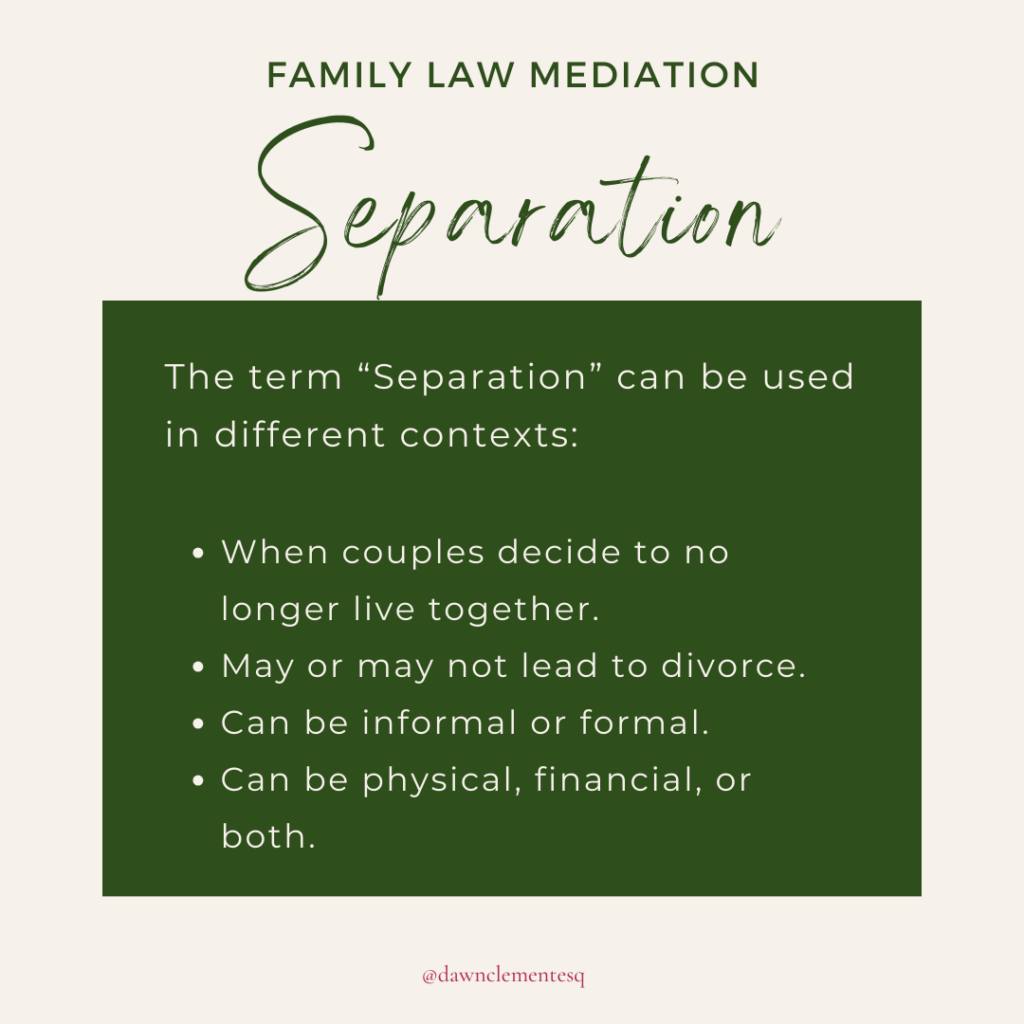
Are you considering separation? If so, it may be helpful to decide on the terms. Generally, there are two types of separation—informal and formal. Whether informal or formal, a separation can be physical, financial, or both.
INFORMAL SEPARATION
In an informal separation or trial separation, couples can use a mediator to agree to terms, including finances, custody, support, and other arrangements, without signing any legal documents.
Read MoreHow Much Does Divorce Cost?
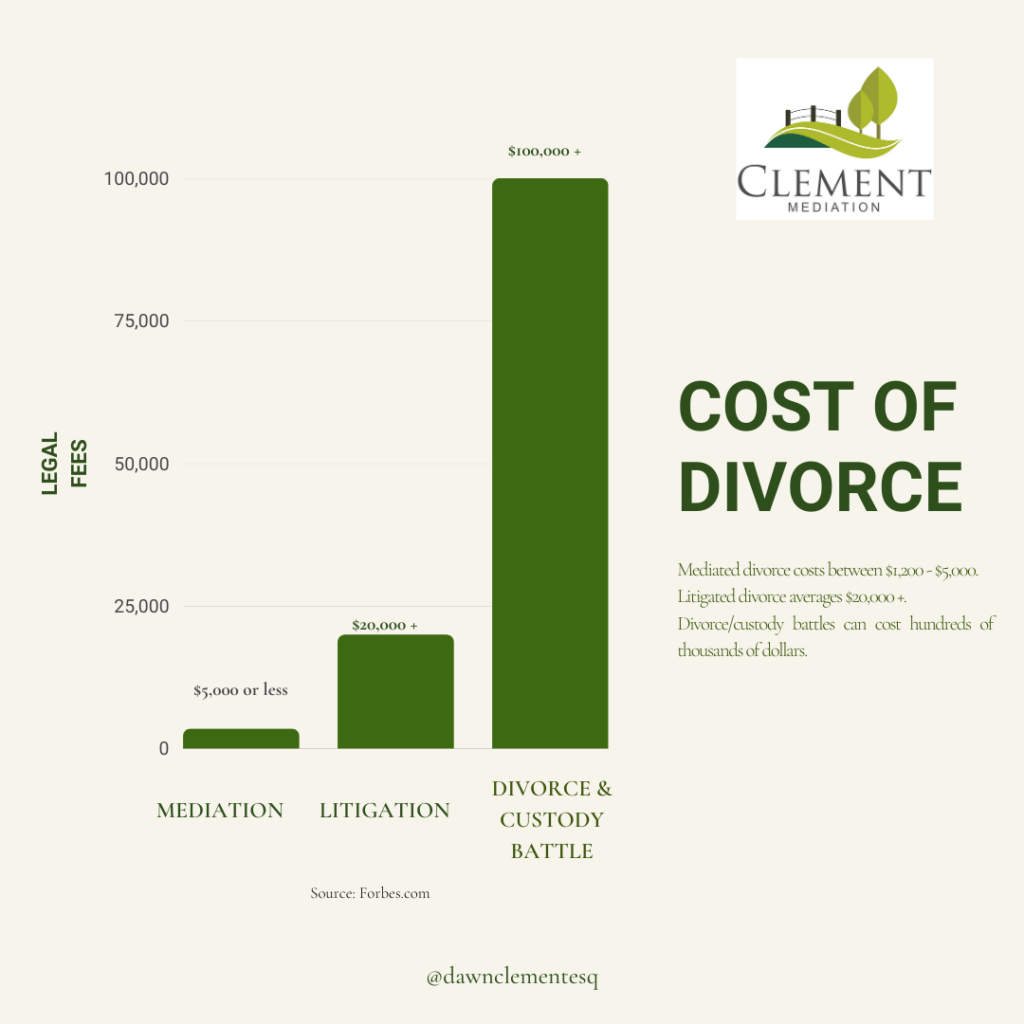
A mediated divorce costs between $1,200 – $5,000.
Litigated divorce averages $20,000 +.
Divorce/custody battles can cost hundreds of thousands of dollars.
Things to Consider Before Divorce

Before starting a divorce, consider taking steps to ensure a smooth mediation process. Rushing into a legal and financial separation is not wise and can end up costing you and your family financial and emotional heartache. Here are a few things to consider before beginning the divorce process. 1. Individual Therapy Working on yourself before…
Read MoreWhy Mediate?

Mediation tends to be peaceful and positive. Most families prefer to make decisions together rather than using an adversarial court process. Mediation encourages cooperation and agreement and is a relatively simple process compared to alternative methods. AVOID COURT! Your family does NOT belong in court. Family matters should be private and confidential. Most parents and…
Read MoreBack to School Co-Parenting Tips

School is starting soon and this can be a difficult time for co-parents. Here are a few tips to ease the transition for the children. Start planning early. As soon as school, sports, and extracurricular schedules are released, share them with the other parent or caregiver so that appropriate scheduling can commence. It may be…
Read More