
Uncoupling
I Think We’re Heading for Divorce. Where Do We Begin?

ntences carry as much weight as this one: “I think we are heading for divorce.”
If you have said those words to yourself recently, you already know the strange mix that follows. Fear sits next to relief. Anger sits next to grief. Some days you feel certain. Other days you doubt everything. None of that means you are handling it wrong. It means you are human, and your marriage mattered.
I want to offer you one piece of relief before anything else: you are not required to solve this today. Not the parenting schedule, not the house, not the retirement account, not any of it. The spouses and parents I work with often arrive at mediation believing they need a full plan before they can take a single step. They do not. What they need first is information.
Slow Down Before You Decide Anything
In my years as an attorney and mediator working with Pennsylvania families, I have watched the earliest weeks shape everything that follows. Spouses who rush into a decision, out of fear or out of anger, often spend years unwinding the consequences of that rush. Spouses who pause long enough to understand their options tend to move through the process with far less damage, financially and emotionally.
So before you decide how to move forward, take time to gather a few things:
An honest list of your household income, expenses, assets, and debts
A clear picture of what your children need, if you are a parent
A realistic read on whether you and your spouse prefer a path that is cost-effective and efficient
None of this requires a decision yet. It only requires clarity.
Court Is Not Your Only Option
Here is something many spouses do not realize until they are already deep into the process: divorce is not one path. It is several.
Litigation sends your family’s decisions to a courtroom, where a judge who has never met you or your children decides what happens to your finances and your parenting time, on a schedule the court controls, through a system built for conflict. Mediation works differently. It keeps those decisions between you and your spouse, guided by conversation rather than courtroom procedure, on a timeline the two of you set together.
Where to Actually Start
If you take nothing else from this, take this: slow down, learn what your real options are, and let your next decision come from intention rather than panic.
Read MoreExpress Divorce Mediation

Separation is rarely simple — but the legal process of formalizing it doesn’t always have to be drawn out. For spouses who have already reached a general understanding and simply need a structured, professional framework to document their agreements, traditional litigation can feel unnecessarily costly and adversarial.
That’s the problem Express Mediation was designed to solve. It’s a streamlined alternative for spouses who are aligned on the essentials and want to move forward with clarity, dignity, and efficiency.
Because the session is structured around efficiency, we ask that both spouses come prepared. This means having thought through your core priorities — property, finances, and if applicable, parenting arrangements — before we sit down together. The clearer your starting point, the more productive the session will be.
Read MoreThe Abandonment Myth
“If I Move Out, I Have Abandoned My Home” — And Other Fears Worth Talking Through
If you are in the middle of a separation and wondering whether leaving the house means losing everything, you are not alone. That fear is one of the most common things I hear. And I want you to know — in most cases, it simply is not true.
First, let us talk about where that fear comes from
The word “abandonment” sounds final. And in a legal context, it does have a specific meaning — in Pennsylvania, marital abandonment refers to one spouse leaving the marriage without the other’s consent, and without justification, for at least one year. The key word there is consent. In divorce mediation, one spouse does not simply disappear in the night. Together, you decide that one person will move out. You agree on a date. You work out how shared expenses will be handled in the meantime. That agreement — that mutual consent — is precisely what distinguishes a planned, mediated separation from litigated legal abandonment. When both spouses are part of the decision, it is not abandonment. It is a plan.
How is Alimony Calculated? A Clear, Practical Guide

How is alimony calculated in Pennsylvania? The answer depends on 17 statutory factors — from the length of your marriage to each spouse’s earning capacity. This guide breaks down what courts consider, how duration is determined, and how mediation can help you reach a fair agreement on your own terms.
Read MoreSurviving Financially After Divorce: Mediation Creates Stability

Financial stability after divorce doesn’t happen by accident. Through mediation, you can create a realistic budget, evaluate housing affordability, structure workable support agreements, and build a long-term financial plan that protects your future. Divorce doesn’t just end a relationship — it reshapes your entire financial life. One of the biggest fears people face after divorce is simple and very real:
“Will I be okay financially?”
The good news? With thoughtful planning — especially through mediation — you can build a stable financial future rather than reacting to a financial crisis.
Read MoreWho Keeps the House in Divorce?

Deciding who keeps the house in divorce involves more than emotion. Learn the pros and cons of mortgage assumption, refinance, cash-out options, and selling — plus key considerations when children are involved.
The family home is more than just real estate — it represents stability, memories, and security. But in separation or divorce, the question is not simply who wants the house? It’s who can afford the house — and the mortgage — moving forward?
If you own a home together, when determining who keeps the house in divorce, there are typically three practical options to consider: mortgage assumption, cash-out refinance, or sale.
Mediation: A Practical Alternative to Court

When families face divorce, the courtroom is not the best option. Mediation offers a practical, respectful path forward—one that is affordable, private, and focused on solutions rather than battles. With the guidance of a neutral mediator, you can resolve your divorce or custody matter and make decisions that keep control in your hands, not the court’s.
Read MoreManaging Conflict Outside of Mediation

Mediation is designed to help separating couples make thoughtful, respectful decisions without the stress of court. But when tensions are high and communication breaks down, the process can feel challenging. With the right structure and mindset, even the most contentious situations can move forward productively.
Read MoreDivorce Mediation After Marriage Counseling
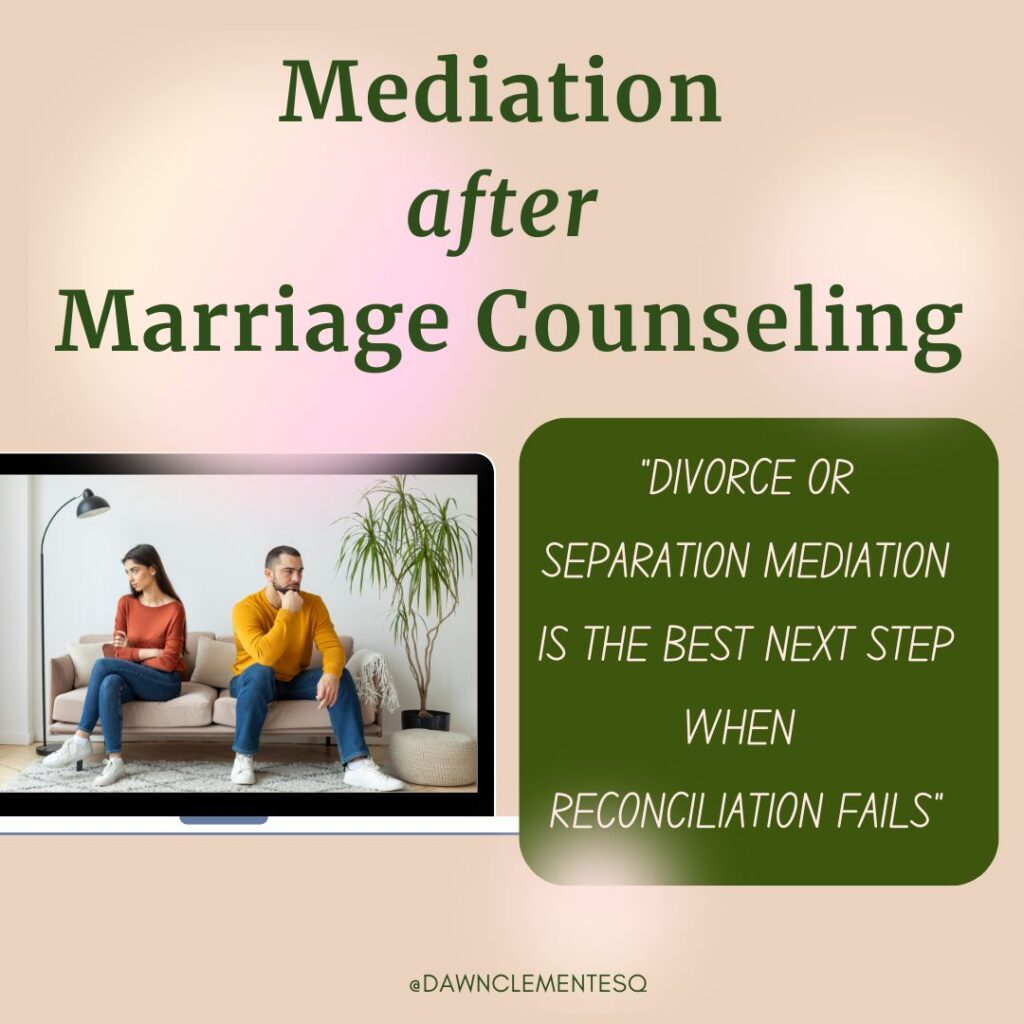
Couples therapists, clergy members, or marriage counselors help spouses and co-parents rebuild trust, improve communication, and strengthen their relationship. However, despite best efforts, some couples reach a point where reconciliation is no longer possible. When this happens, the transition away from the relationship can be just as crucial as the attempts to save it.
Read MoreHow to Talk to Your Spouse About Mediation

Discussing divorce or custody mediation with your spouse or co-parent can be challenging, especially during times of conflict. Even though mediation is the optimal choice for families, having the initial conversation may be difficult. Where to begin? Before initiating the discussion, it is helpful to prepare yourself for the conversation about mediation. First, gather the…
Read More